

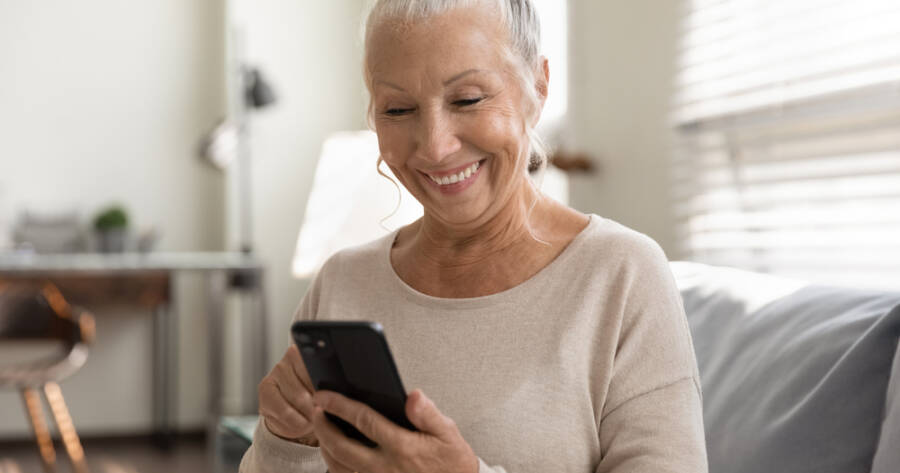
Staying connected has never been more important, especially for older adults who value safety, simplicity, and reliability. Modern cell phones now offer features designed specifically with seniors in mind, combining ease of use with helpful technology. From basic flip phones to advanced smartphones, the right device can support independence, communication, and everyday confidence.
Best Simple Flip Phone: Consumer Cellular IRIS Easy Flip 2
The IRIS Easy Flip 2 is a strong choice for someone who primarily wants calling and texting without navigating a complicated smartphone. Its physical keypad uses large, backlit letters, while the interface offers straightforward menus and quick access to favorite and emergency contacts. A 3.2-inch internal display and 2.8-inch outer screen provide information without requiring a touchscreen (source).
It also includes hearing-aid compatibility, Wi-Fi, Bluetooth, a magnifier, flashlight, and a 5MP camera. Battery life is rated at up to 15 hours of talk time. This combination makes the phone particularly suitable for older adults who value a traditional design but still want useful modern connectivity (source).
Best Senior-Focused Smartphone: Jitterbug Smart5
For someone who wants smartphone functions without an unnecessarily complicated interface, the Jitterbug Smart5 provides a middle ground. Its 6.75-inch screen uses large text and a simplified list-style menu, while voice typing and a built-in voice assistant can reduce the amount of touchscreen typing required. It also supports 5G, Wi-Fi calling, live call captions, and a 50MP rear camera (source).
An optional Urgent Response service adds access to emergency assistance through a dedicated button. These safety services require a compatible Lively plan and can increase the monthly cost, so buyers should compare the complete service expense rather than looking only at the phone price (source).
Best Familiar Smartphone: iPhone 17
Older adults who already understand smartphones—or have family members who can help with setup—may prefer the iPhone 17 rather than a device specifically marketed to seniors. Current iPhones include extensive accessibility tools for users with different vision, hearing, mobility, and reading needs, including VoiceOver, Magnifier, Voice Control, larger text options, and support for compatible hearing devices (source).
Safety capabilities can add another benefit. Current iPhones support features such as Emergency SOS and Crash Detection, which can contact emergency services after certain serious vehicle collisions when the required conditions are met (source). The iPhone is therefore better suited to seniors who want a full-featured smartphone and are comfortable with a more extensive selection of apps and settings.
Best Affordable Android Option: Samsung Galaxy A16 5G
The Samsung Galaxy A16 5G provides a more conventional Android experience at a lower price point than many premium smartphones. Its large display can be helpful for reading messages, viewing photographs, or making video calls, while a 5,000mAh battery is designed to provide substantial use between charges. Samsung also provides hearing-enhancement and other accessibility settings across compatible Galaxy devices (source).
This model makes more sense for seniors who are reasonably comfortable with smartphones and want access to familiar Android apps without paying flagship-phone prices. Someone who finds standard smartphone menus overwhelming may be better served by the Jitterbug or a flip phone.
Best for Cognitive Impairment: RAZ Memory Cell Phone
The RAZ Memory Cell Phone serves a very different purpose. It is designed for people who may struggle with conventional smartphone navigation, including some users experiencing dementia or cognitive decline. Calls can be placed by selecting large contact pictures, while caregivers can remotely manage contacts, settings, battery information, and the phone’s location through a companion app (source).
The streamlined interface deliberately limits distractions and complexity. Caregivers can also control incoming-call settings and configure emergency-calling options. For families prioritizing simplicity and remote assistance over apps and entertainment, this specialized design can be more appropriate than either an ordinary smartphone or flip phone (source).
Which Cell Phone Is Best for a Senior?
There is no single phone that works best for every older adult. The IRIS Easy Flip 2 suits people who want straightforward calling and physical buttons, while the Jitterbug Smart5 combines smartphone capabilities with simplified navigation and optional safety services. The iPhone 17 and Galaxy A16 5G offer more traditional smartphone experiences for confident technology users, while the RAZ Memory Cell Phone addresses situations where cognitive accessibility and caregiver involvement are the priority.
Before buying, consider the person’s eyesight, hearing, dexterity, familiarity with technology, desired safety features, and willingness to learn a new interface. Choosing around those practical needs is more useful than simply buying the phone with the longest feature list.